
12x16 Shed Plans: Detailed Blueprints, Framing Layouts & Full Material List
Get detailed 12x16 shed plans with precise framing layouts, a verified material list, and step-by-step building logic. Everything you need before buying lumber.
Advertorial: This story reflects the personal experience of the author. We may receive compensation from the products mentioned.
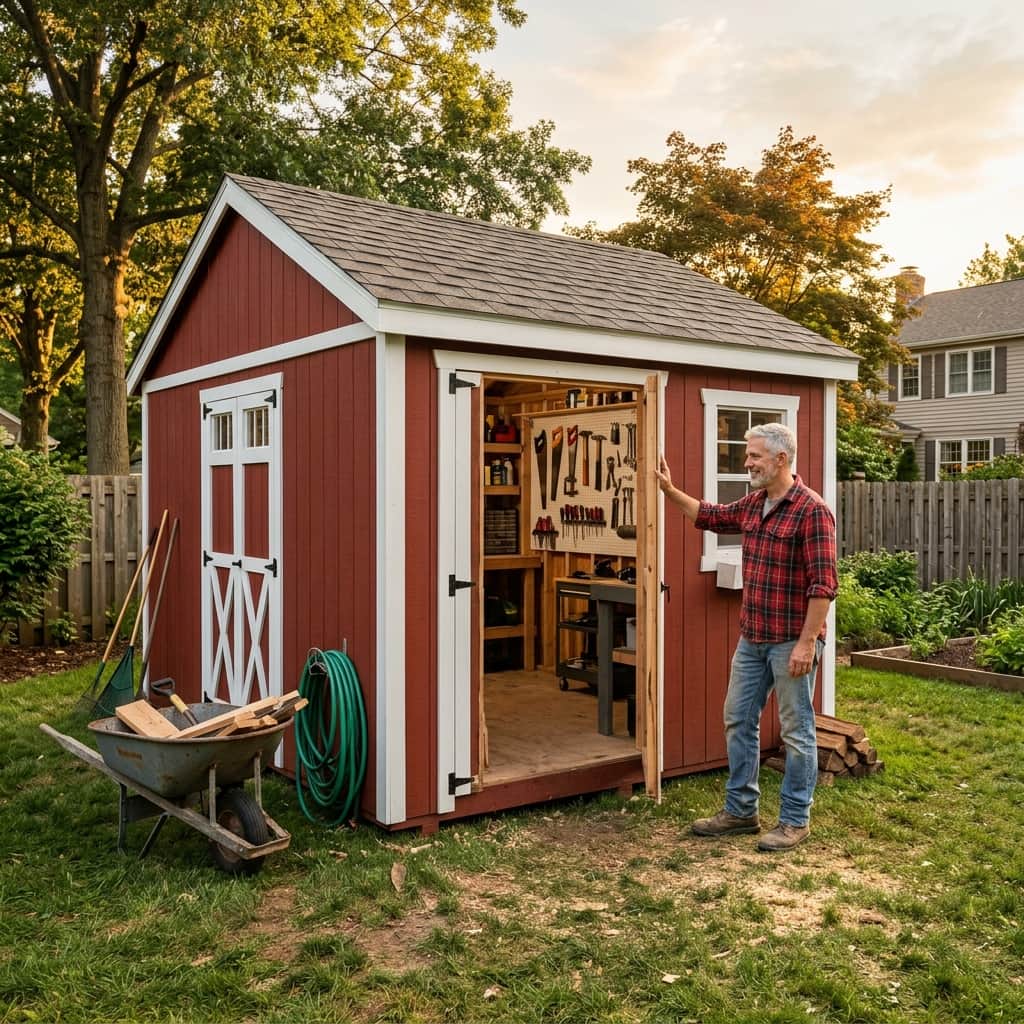
A 12x16 shed is the most popular shed size in America for a reason — and it's also the size where bad plans cost you the most money.
At 192 square feet, you're working with enough lumber to frame a small room addition. One wrong measurement on your wall plates, one miscounted rafter, and you're staring at a pile of expensive mistakes in your driveway.
This guide breaks down every detail of 12x16 shed plans — from foundation to ridge cap — with the kind of precise framing layout blueprints and verified material lists that generic free PDFs never include. By the end, you'll walk into the lumber yard knowing exactly what goes on the cart.
Why 12x16 Is the Most Requested Shed Size
Space vs. Permit Threshold
A 12x16 footprint gives you 192 square feet. That's 60% more usable space than a 10x12, which means room for:
- A full-size riding mower plus push mower
- A 6-foot workbench along one wall
- Floor-to-ceiling shelving on two walls
- Overhead loft storage above the door wall
The trade-off: at 192 sq ft, you will almost certainly need a building permit in most U.S. jurisdictions. The common exemption threshold is 120 sq ft — and this shed is well above it.
Do not skip the permit. A 12x16 shed requires a permit in the vast majority of U.S. counties. Typical costs run $75–$300 depending on your municipality. Building without one risks fines, forced demolition, or problems when you sell your home. Call your local building department before you pour a single footer.
Framing Efficiency at 12x16
This footprint aligns perfectly with standard lumber lengths:
- 12-foot and 16-foot boards are the two most common stock lengths at any lumber yard.
- Floor joists, wall plates, and ridge boards all use these lengths with zero or near-zero waste.
- Roof sheathing (4x8 OSB panels) tiles perfectly across a 16-foot span with no rip cuts needed on the length.
When your building dimensions match standard lumber lengths, you save money and time. That's not accidental — it's the entire reason experienced builders prefer 12x16.
Foundation Options for a 12x16 Shed
At this size, your foundation choice matters more than it does on a smaller shed. The weight of the structure and the floor load demand a solid base.
Option 1: Gravel Pad with Pressure-Treated Skids
The most common DIY approach. Works well on flat, well-drained lots.
- Excavate and compact a 14x18 gravel pad (1 foot wider than the shed on each side for drainage).
- Lay (4) 4x6x12 PT skids parallel, spaced evenly.
- Build your floor frame on top.
Cost: ~$200–$400 for the gravel and skids.
Option 2: Concrete Block Piers
For sloped sites or areas with heavy clay soil.
- Set (9) solid concrete blocks at corners, midpoints, and center.
- Level them precisely using a laser level or water level.
- Set the floor frame on pier brackets.
Cost: ~$150–$300 for blocks and brackets.
For a 12x16 shed, I always run four skids instead of three. The additional center-span support prevents floor bounce when you're rolling heavy equipment across it. Space them at 0", 48", 96", and 144" from one edge.
Detailed 12x16 Shed Floor Framing
The floor frame is the skeleton that everything else sits on. Get this wrong and every wall you raise will be out of square.
Floor Frame Components
- Rim joists (band boards): (2) 2x8x16 PT — the long sides of the rectangle
- End joists: (2) 2x8x12 PT — the short sides
- Interior floor joists: (11) 2x8x12 PT at 16" OC
- Subfloor sheathing: (6) sheets 3/4" T&G OSB (4x8)
Why 2x8 Instead of 2x6?
A 12-foot joist span with 2x6 lumber is at the absolute edge of the allowable span for residential floor loads (40 PSF live + 10 PSF dead). A 2x8 gives you a comfortable margin and eliminates floor bounce — especially important if you're storing heavy equipment or building a workshop.
All floor lumber must be pressure-treated (PT) rated for ground contact. Look for the stamp "UC4A" or "Ground Contact" on the end tag. Regular SPF lumber will rot within 2-3 seasons when exposed to moisture from the gravel bed.
Squaring the Floor Frame
Before fastening your subfloor:
- Measure both diagonals (corner to opposite corner).
- They must be exactly equal. If they differ, rack the frame until they match.
- For a 12x16 rectangle, the diagonal should measure exactly 20 feet (by the Pythagorean theorem: √(12² + 16²) = 20).
- Once square, screw the frame to the skids and begin laying subfloor.
12x16 Wall Framing Layout: The Complete Breakdown
This is where detailed 12x16 shed plans earn their value. Generic plans show you a rectangle with lines. Proper blueprints show you every stud, every cripple, every header — with exact lengths.
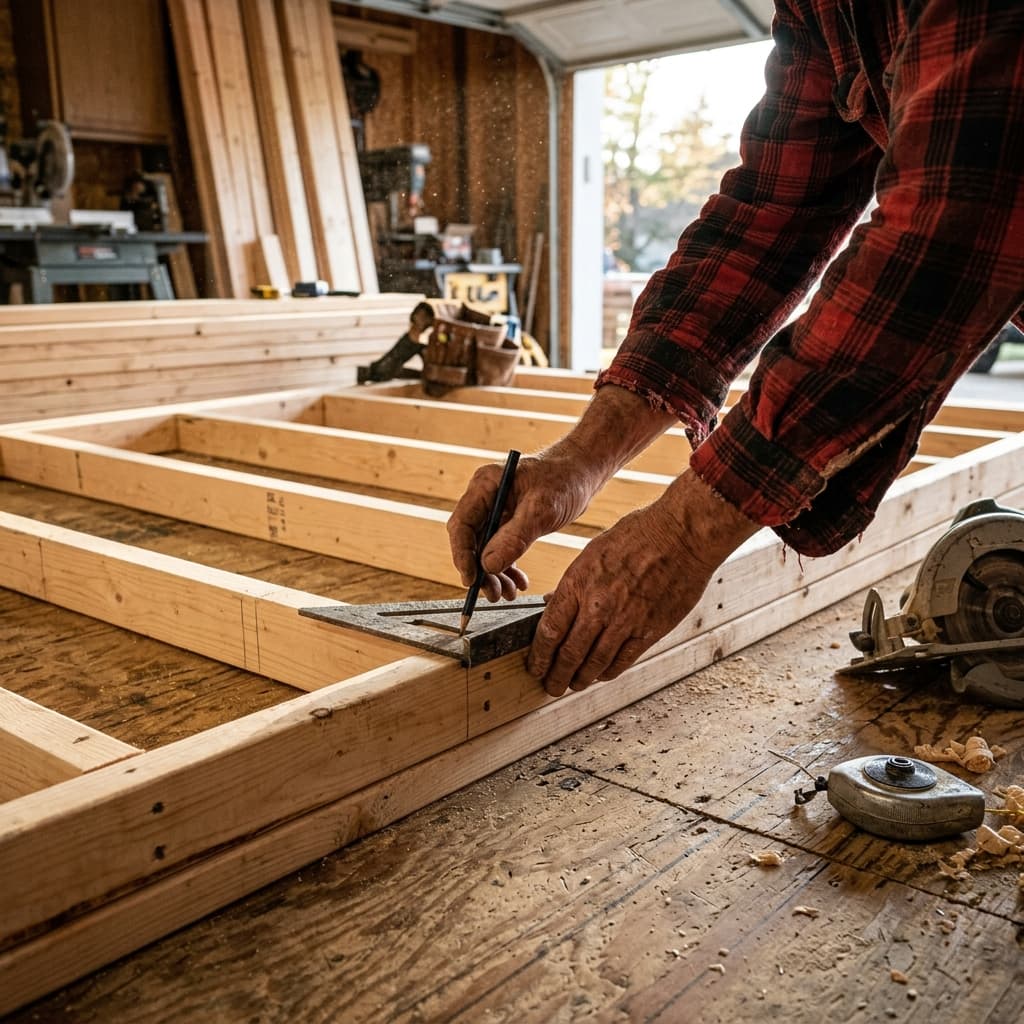
Stud Layout at 16" On Center
For standard 8-foot walls:
16-foot walls (front and back):
- Bottom plate: (1) 2x4x16
- Top plate: (1) 2x4x16
- Double top plate: (1) 2x4x16
- Studs: (13) 2x4x92-5/8" pre-cut
- Plus king studs, jack studs, and cripples for any door/window openings
12-foot walls (sides):
- Bottom plate: (1) 2x4x12
- Top plate: (1) 2x4x12
- Double top plate: (1) 2x4x12
- Studs: (10) 2x4x92-5/8" pre-cut
Door Rough Opening
For a standard 6-foot wide shed door (double door):
- Rough opening width: 72" (6 feet)
- Rough opening height: 82"
- Header: (2) 2x6x76" with 1/2" OSB spacer sandwiched between
- (2) king studs full height
- (2) jack studs (trimmers) cut to header height
- Cripple studs above header at 16" OC
When framing the double top plate, overlap the corners. The front wall's double plate should extend past the side wall by 3.5" (the width of a 2x4), and vice versa. This locks the corners together structurally. It's how real house framing works, and it's the single most important detail most shed plans skip.
Roof Framing: Gable Roof for a 12x16 Shed
Choosing the Right Pitch
For a 12-foot span (the short dimension), common pitches are:
- 4/12 pitch: 24" of rise over the 6-foot half-span. Minimum for asphalt shingles.
- 6/12 pitch: 36" of rise. Better water shedding, more attic storage potential, more visual appeal.
- 8/12 pitch: 48" of rise. Steeper — looks great, but requires more lumber and more confident carpentry.
I recommend 6/12 for most 12x16 sheds. It balances aesthetics, water shedding, and lumber cost.
Rafter Specs at 6/12 Pitch
- Rafter run: 6'0" (half of 12-foot span)
- Rafter rise: 36" (6/12 × 72")
- Rafter line length: approximately 80.5" (hypotenuse)
- Total rafter board: 2x6x8 — cut to line length plus overhang (typically 12"–18")
- Rafter count: (18) total — 9 pairs at 24" OC, or (22) at 16" OC for heavier snow loads
- Ridge board: (1) 1x8x16
At 6/12 pitch on a 12-foot span, your ridge will sit 3 feet above the top plate. Make sure your total building height (foundation + walls + ridge) stays within your local zoning maximum. Many residential zones cap accessory structures at 12-15 feet. Measure and verify before framing the roof.
Collar Ties and Wind Bracing
- Install collar ties (2x4) on every other rafter pair, positioned in the upper third of the rafter span.
- In high-wind zones, add hurricane ties (Simpson H2.5 or equivalent) at every rafter-to-plate connection.
The Complete 12x16 Shed Plans Material List
Here is a field-verified 12x16 shed plans material list for a gable-roof shed on a skid foundation with a 6-foot double door, one window, and 6/12 roof pitch.
Foundation & Floor
- (4) 4x6x12 PT skids
- (11) 2x8x12 PT floor joists
- (2) 2x8x16 PT rim joists
- (6) sheets 3/4" T&G OSB subfloor (4x8)
- (11) LUS28 joist hangers
- (2) tubes construction adhesive
- (3) lbs 16d ring-shank nails
Wall Framing
- (70) 2x4x92-5/8" pre-cut studs (includes corners, trimmers, cripples)
- (4) 2x4x16 plates (front/back bottom + top)
- (4) 2x4x12 plates (side bottom + top)
- (4) 2x4x16 double top plates (2 front/back, plus overlaps)
- (4) 2x4x12 double top plates (2 sides, plus overlaps)
- (2) 2x6x76" door header boards
- (1) strip 1/2" OSB header spacer
Roof Framing
- (18) 2x6x10 common rafters (cut to length + overhang)
- (1) 1x8x16 ridge board
- (6) 2x4x6 collar ties
- (2) 1x6x16 fascia boards
- (4) 1x6x10 rake boards
- (10) sheets 7/16" OSB roof sheathing (4x8)
Roofing
- (2) rolls 30# felt underlayment
- 70 LF aluminum drip edge
- (7) squares architectural shingles
- (1) bundle ridge cap shingles
- (1) 5 lb box 1.75" roofing nails
Siding & Trim
- (16) T1-11 siding panels (4x8) — includes gable triangles
- (16) 1x4x8 corner and door trim boards
- (4) 1x3x8 window casing
- (8) 8' Z-flashing pieces
Hardware & Finish
- (1) 6' pre-hung double shed door (or build from T1-11 + Z-brace)
- (1) 24"x24" shed window
- (8) Simpson H2.5 hurricane ties
- (2) boxes 3" exterior screws
- (2) boxes 1-5/8" exterior screws
- (1) tube exterior caulk
- (2) gallons exterior primer
- (3) gallons exterior paint
Estimated Lumber Cost (2026 Prices)
For SPF framing lumber at current national average pricing:
- Foundation & floor: $450–$600
- Wall framing: $350–$500
- Roof framing: $300–$450
- Roofing materials: $400–$550
- Siding, trim, hardware: $500–$700
- Total estimated material cost: $2,000–$2,800
Prices vary significantly by region. Coastal and urban areas typically run 15-25% higher than the Midwest. Get quotes from at least two lumber yards before committing — contractor pricing desks at smaller yards often beat big-box store pricing for bulk orders.
Getting Professional-Grade Blueprints
The material list above tells you what to buy. But knowing what to buy and knowing exactly how to assemble it are two different things.
Professional-grade diy 12x16 shed blueprints include dimensioned elevation drawings, exploded 3D assembly diagrams, rafter templates with exact bird's mouth and plumb cut angles, and door construction details that generic plans simply don't cover.
If you want engineer-verified plans with zero guesswork for the 12x16 and hundreds of other shed sizes and styles, this is the resource I've used for years:
Frequently Asked Questions
How much does it cost to build a 12x16 shed?
Materials alone typically run $2,000–$2,800 depending on your region and lumber prices. If you hire a contractor, expect $5,000–$8,000+ for the same build. The DIY route saves you roughly 50-65% — and you get a structure built with real lumber instead of the thin OSB panels used in prefab kits.
Do I need a permit for a 12x16 shed?
Yes, in almost all U.S. jurisdictions. A 12x16 shed is 192 square feet — well above the common 120 sq ft permit exemption. You'll need to submit a site plan showing setbacks from property lines and may need to show construction drawings. Permit fees typically run $75–$300.
How many sheets of plywood do I need for a 12x16 shed floor?
You need (6) sheets of 3/4" tongue-and-groove OSB or plywood (4x8 each). The 16-foot dimension runs along the length, so you'll lay 2 sheets across the 12-foot width (with a rip cut on the second row) and 4 sheets along the 16-foot length, staggering the joints for structural integrity.
Can I build a 12x16 shed by myself?
Yes, but plan for two weekends minimum. Weekend one: foundation and floor framing. Weekend two: wall framing, raising, and sheathing. Weekend three: roof framing and roofing. A helper is essential for raising the 16-foot walls — they're heavy and unwieldy for one person. Pre-cutting all your lumber using a verified cut list is the biggest time-saver for a solo builder.
All dimensions and material quantities in this guide are based on standard U.S. residential construction practices using dimensional SPF lumber. Always verify local building codes and adjust specifications with a licensed professional if required in your jurisdiction.
Keep your edges sharp,
– Mark