
Why Cedar is the Best Wood for Garden Sheds
Pressure-treated pine is cheaper. But if you want your shed standing in 20 years, cedar is worth every extra dollar. Here's why.
The $200 Question: Cedar or Pine?
You're at the lumberyard.
You've got two options for your shed framing:
- Pressure-treated pine – $4.50 per 2x4
- Cedar – $8.50 per 2x4
For an 8x10 shed, that's roughly a $200 difference.
Your wallet says pine. Your gut says cedar.
Let me settle this for you: If you're building a shed that touches the ground or sits outdoors year-round, cedar is the only smart choice for certain components.
Here's why.
What Makes Cedar Different
Cedar isn't just "nice wood."
It has natural properties that make it perfect for outdoor projects:
1. Natural Rot Resistance
Cedar contains natural oils (thujaplicins) that resist decay.
Translation: It doesn't rot when it gets wet. Pine? Without chemical treatment, it'll start decomposing within 2-3 years of ground contact.
Even pressure-treated pine will eventually break down. Cedar lasts decades without a single coat of sealant.
2. Insect Resistance
Termites, carpenter ants, and wood borers hate cedar.
Those same natural oils that prevent rot also repel insects. It's like built-in pest control.
Real-world example: I built a raised garden bed with cedar 8 years ago. No termite damage. My neighbor used pine. Replaced it twice.
3. Dimensional Stability
Wood expands and contracts with humidity. It's why doors stick in summer and gaps appear in winter.
Cedar has a low shrinkage rate. It moves less than pine, oak, or fir.
Why this matters for sheds: Your siding won't warp. Your door will still close. Your structure stays square.
4. Lightweight (But Strong)
Cedar is 30% lighter than pressure-treated pine, but nearly as strong in compression.
Translation: Easier to carry, easier to cut, less strain on your shed's foundation.
Where to Use Cedar (And Where to Save Money)
Here's the smart strategy.
You don't need to build the entire shed out of cedar. That's overkill (and expensive).
Use cedar where it counts:
Use Cedar For:
- Siding – The exterior face that takes rain, sun, and snow
- Trim and fascia – Exposed wood that frames your roofline
- Posts touching the ground – In contact with moisture and soil
- Door and window frames – Prevents warping and ensures smooth operation
Use Pressure-Treated Pine For:
- Floor joists – Sit on pavers or concrete, less exposure
- Wall studs (interior) – Covered by siding and drywall, protected from elements
Use Regular Pine/Fir For:
- Roof trusses and rafters – Covered by shingles, stays dry
- Interior shelving – Climate-controlled, no moisture
When working with cedar, always use stainless steel or hot-dipped galvanized fasteners. Standard steel screws will react with cedar's natural oils, causing ugly black streaks (bleeding) and eventually corroding the metal.
Buy rough-cut cedar from a local mill instead of Home Depot. You'll save 30-40% and get better quality.
Cedar vs. Pressure-Treated Pine: The Real Comparison
Let's break down the numbers over 20 years.
The cost of maintenance often exceeds the cost of materials. In 20 years, you'll spend far more time and money repairing pine than you would have spent upgrading to cedar initially.
Pressure-Treated Pine Shed:
- Initial cost: $1,200 in materials
- Year 5: Siding starts to warp, needs paint touchup ($150)
- Year 10: Replace rotted trim boards ($200)
- Year 15: Replace bottom siding panels ($400)
- Year 20: Major repairs or full rebuild ($1,500+)
Total 20-year cost: ~$3,450
Cedar Shed (Strategic Use):
- Initial cost: $1,400 in materials (cedar where it counts)
- Year 5: Optional stain refresh ($100, purely cosmetic)
- Year 10: Nothing
- Year 15: Nothing
- Year 20: Still looks great
Total 20-year cost: ~$1,500
Cedar actually saves you $2,000 over the life of the shed.
The One Thing Cedar Can't Do
Let's be honest.
Cedar is amazing, but it's not magic. There's one critical thing you still need:
A proper plan.
I've seen people spend $2,000 on premium cedar, build a shed with no overhang on the roof, and watch rain run straight down the siding into the foundation.
All that rot-resistant wood... rotting. Because water pooled where it shouldn't.
The lesson: The best materials in the world can't fix a bad design.
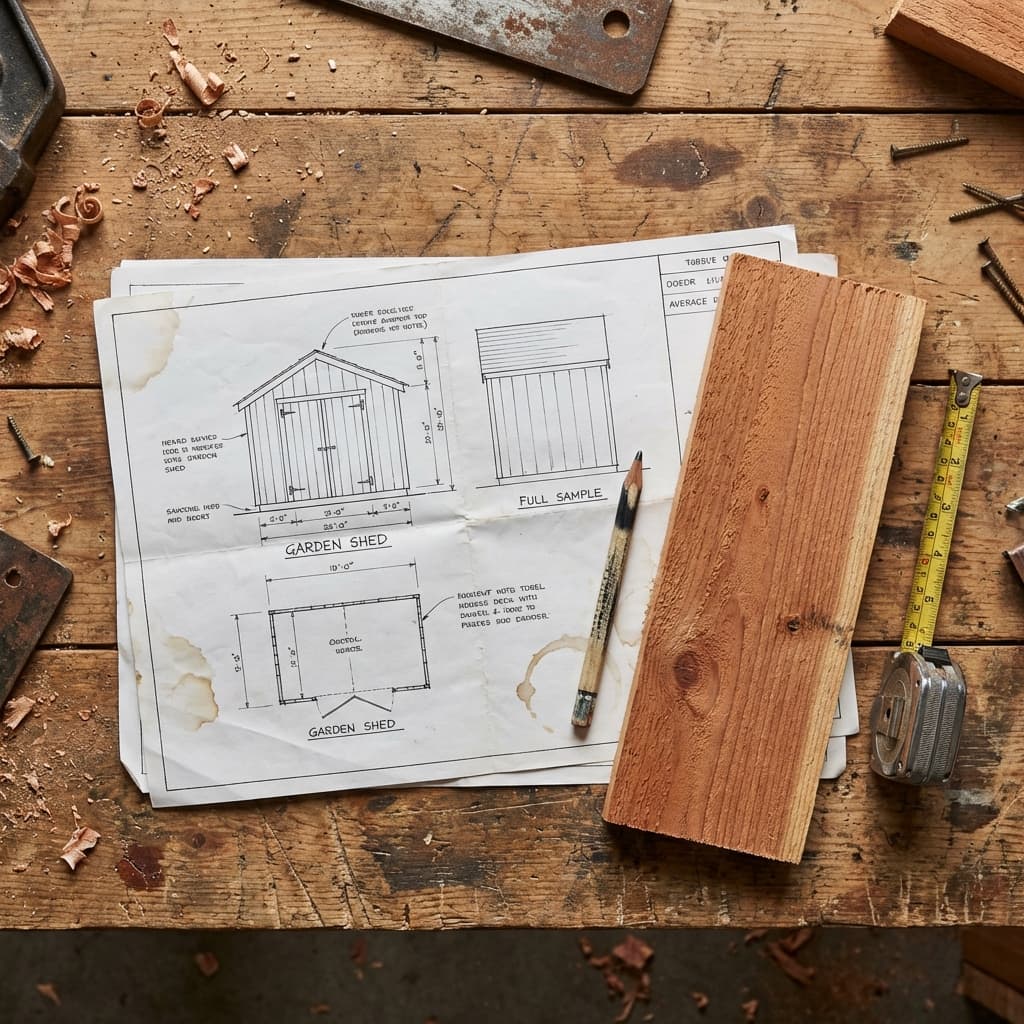
A verified plan will tell you:
- Where to use cedar vs. treated lumber (saves money)
- How to design roof overhangs to protect siding
- Proper ventilation to prevent moisture buildup
You're investing in cedar because you want it to last. Make sure your design matches that goal.
How to Spot Quality Cedar
Not all cedar is created equal.
When you're at the lumberyard, look for:
1. Heartwood (Dark Red)
The center of the cedar tree. This is where the natural oils are concentrated.
Avoid: "Sapwood" cedar (light tan/white color). It's the outer part of the tree. Less rot resistance.
2. Tight Grain
Look at the end of the board. You want tight, closely-spaced growth rings.
Why: Tighter grain = slower growth = stronger, more stable wood.
3. Minimal Knots
Some knots are fine (they're natural). But avoid boards with:
- Large knots (bigger than a quarter)
- "Dead" knots (black, loose, falling out)
- Knots in the middle of the board where you'll cut
4. Straight and True
Sight down the board like you're aiming a rifle. It should be straight.
Warped cedar is still rot-resistant, but it's a pain to work with.
The Bottom Line on Cedar
If you're building something temporary (a quick storage box, a temporary fence), use pine. Save your money.
If you're building something you want standing in 20 years (a garden shed, a deck, a pergola), use cedar where it matters.
The math is simple:
- Cedar costs 30-40% more upfront
- Cedar lasts 2-3x longer than treated pine
- Cedar requires almost zero maintenance
It's not about being fancy. It's about being smart with your money long-term.
One Final Tip
Cedar naturally weathers to a silver-gray patina if you leave it untreated.
Some people love that look (I do). Others prefer the rich red-brown color.
If you want to preserve the original color:
- Apply a UV-protective sealant within the first 3 months
- Reapply every 2-3 years
If you like the gray look?
- Do nothing. Let it age naturally. It's still fully protected.
Either way, you've built something that'll outlast you.
Choose your materials wisely. Build once, enjoy for decades.
– Mark